




Namaste from the Indian capital of Delhi, where we are staying with our friends Andrew and Vibha. They have been great hosts, introducing us to momo dancing, Bollywood basslines and showing us a side of the city we would never have seen on our own. Thanks guys! More on that next time, because the blog is still lagging a few weeks behind us, so let’s bring you up to speed.
On the way down from Ooty on the old steam train we adopted a resourceful Canadian called Kristen who was traveling around India alone. Brave girl. She told us that earlier in her trip she had met an Indian man who had invited her back to his village so he could give her some Ayurvedic treatments. She agreed, and stayed with him in his tiny mud hut, sharing his food and receiving a daily massage and ‘lessons’. A week later she emerged into the blazing sun, covered in essential oils and mosquito bites, and made her way back to town. Personally I would have been tempted to press charges on him but she says she felt reborn and enjoyed t experience.
On the train journey to Kerala with Kristen we learned a valuable lesson on using Indian railways. Up until then we had been travelling in Sleeper Class, where you are allocated a seat which converts into a bunk at night, and you lie like a sardine, attempting to sleep through the liberal use of the train’s horn.
Feeling brave and adventurous with our new Canadian friend we decided to try our luck in General Class to see what conditions were like in the cheapest carriage. The answer to that question is cramped. Every square inch was filled with people or produce, forcing us to stand with our huge rucksacks in the only available space – the toilet, which smelt a bit like Satan’s left armpit.
Talking to keep our spirits up and sipping neat rum to numb ourselves from the smell, we quickly formulated a plan to get ourselves bunked-up to a higher class carriage. When the train stopped at the next station we made good our escape, tip-toeing precariously through the mass of bodies, the damp undersides of our rucksacks brushing against the face of a poor Indian chap who was sleeping on the train floor. Our mission was a success though, and after popping 500 rupees in the pocket of the ticket inspector we spent the rest of the journey in a spacious air-conditioned carriage, still drinking the rum of course.
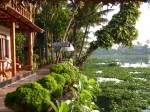
Kerala is bloody hot. So hot that you have to take at least four showers a day just to stay the right side of sanitary. The scenery more than makes up for it though, with beautiful old colonial towns, long sandy beaches and vast expanses of backwaters where life has stood still for hundreds of years.
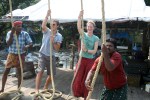
Our first stop on our Keralan tour was the quaint little town of Fort Cochin, a port used by the British in ye days of olde. Here we helped the local fisherman bring in their catch using traditional Chinese fishing nets, and then, after selecting a few choice specimens, got them cooked on one of the grills on the street with a bit of butter and garlic. Lovely.
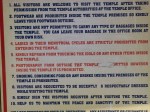
We also spent some time with a nice couple called Jade and James from East London who we met while browsing antiques in the old Jewish quarter of Fort Cochin. We ate a lot of Italian food, swapped stories of our travels and taught them advanced Shithead (a card game) strategy over some beers. Fort Cochin also had some lovely Jain temples which we would have visited, but alas, one of the girls was menstruating or ‘cursed’, which forbade us from entering. Quite how they would know was a mystery but we didn’t want to offend anyone.
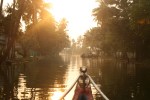
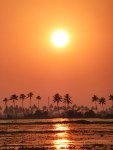
Bidding farewell to the East Londoners we headed to Allepeppey which is right on the backwaters of Kerala. The monsoon clouds which sweep up from the South are stopped by the Western Ghats, forcing them to dump their rain in one go and thus creating a huge area of lakes, canals and channels. Life is slow, relaxed and rural, with the calm only broken by the rice barges which chug up the channels, ferrying tourists around the lush watery paradise. Our meager budget did not quite extend to a barge, but we rented a sweet little gondola which could go down some of the smaller channels and was a great way to see the sun come up, even if our captain did insist on blasting out Akon and Michael Jackson at 20,000 decibels.
Next stop was Varkala, a small cliff-top strip of shops, bars and restaurants which overlooks a beach where the waves are big enough to surf and the seafood is good enough to eat. The town itself was a bit of a disappointment, and the touts were not in great spirits at the end of a long and not particularly prosperous season, so we were glad when we met up with James and Jade again. James and I attempted surfing and managed to kneel on the board for about three seconds, and then at night we gorged ourselves on seafood and drank beer out of teapots in the unlicensed bars.
We also did a cooking course, learning how to throw together tarka dhal, vegetable jalfrezi, paratha, vegetable biryani, samosas and a dessert made out of bananas and milk whose name escapes me. Despite one of the main ingredients being our own sweat, the food was delicious, and enough to feed us for the next three meals.
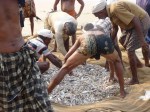
We should be proficient fisherman by now, because in Varkala we yet again helped the men bring in their catch, this time using a huge drag net. We then watched with mild amusement as an argument erupted after one of the men, (wearing the world’s tightest lungi) blamed the size of the catch on a decision that one of the other fisherman had made prior to our arrival.
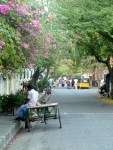
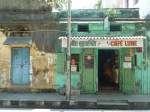
Pondicherry is an old French colony, where the guidebook assured us we would eat the juiciest steak and drink the finest wine that money could buy. Well the steak and wine wasn’t quite as delicious as the guidebook promised, but if you ignored the hooting traffic and bright yellow rickshaws you could fool yourself into believing that you were in a picturesque French town. The buildings were very pretty, there was great coffee and the policeman still donned the Kepi hats that the french wear. We also stayed in a lovely french-style villa with hot water (big luxury for us) and a television which certainly added to our enjoyment of the place.
A half hour motorbike drive from Pondi was Auroville, a self-sufficient community started by ‘The Mother’ back in the 1960s. There is no religion and each one of the 5,000 inhabitants works towards the good of the community, while striving for a greater sense of oneness, dude. In the middle of the vast settlement is a huge golden globe, which houses the world’s largest crystal which the Aurovillians use to meditate around. You’re only allowed to view the globe after you have watched a video, and I don’t know whether we were brainwashed by that video, because afterwards we were rather seduced by the idea of living alongside these alternative-lifers.
Next stop was Chennai. No person has ever had a good thing to say or write about Chennai, so we arrived there late at night, got driven to our hotel by a rickshaw (piloted by a very drunk driver), stayed one night and then flew to the Andaman Islands the next day. And that, our friends, is where we shall pick up the journey next time.
Hope you are all well and that we speak to you soon,
Michael and Pipa xxx


 Never a Dahl Moment